
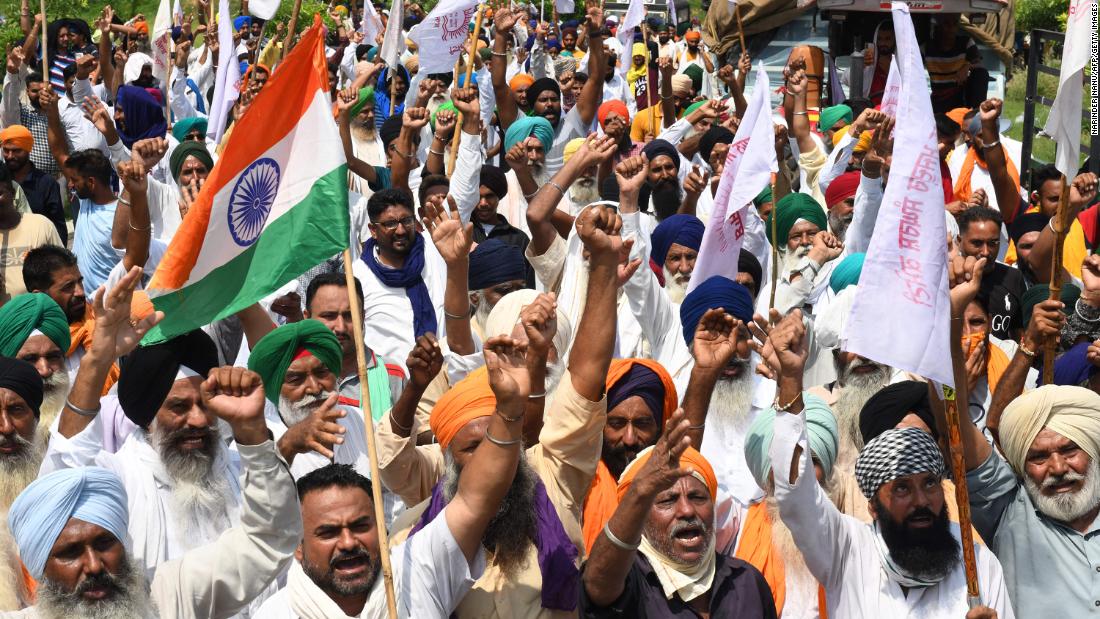
In an address to the nation, Modi said, “Today I have come to tell you the whole country that we have decided to withdraw all three agricultural laws.” The process will be completed in the parliamentary session later this month.
Modi acknowledged the importance of farmers and the challenges they face. He said it was a priority issue for his ruling Bharatiya Janata Party (BJP).
In this great campaign to improve the condition of the farmers, three agricultural laws were brought in the country, Modi said.
“This law was brought in with good intentions,” he said, adding that despite its efforts, the government “was unable to explain to them (the farmers) the importance of agricultural laws.”
Deepak Lamba, national vice president of Jai Kisan Andolan Kisan Group, said Modi’s announcement could be seen as “a big victory for farmers,” but added that the government repealed the laws for “political compulsions”. Is.
“The government has taken this step keeping in mind the upcoming (state) elections,” he said.
In India, farming is a central political issue, and the protests posed a unique challenge to the BJP.
Elections will be held in seven Indian states early next year to determine whether Modi’s BJP will retain power. His ruling party currently governs six of the seven states, including agrarian Uttar Pradesh.
Farmers are the largest voting bloc in the country, and the agriculture sector supports about 58% of India’s 1.3 billion citizens. Angry farmers could see Modi losing a large number of votes.
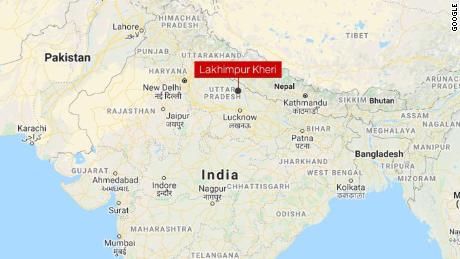
Modi’s announcement came on Guru Parv, the birth anniversary of Guru Nanak, the founder of Sikhism. Sikhism is the dominant religion in the northern state of Punjab, which is governed by the opposition Congress Party and is considered India’s bread basket for its great agricultural power.
However, some farmer groups vowed to maintain the pressure.
Rakesh Tikait, leader of the Bharatiya Kisan Sangh, wrote on Twitter: “The protest will not be withdrawn immediately.”
“We will wait for the day when agriculture laws will be repealed in Parliament.”
The farmers’ group of the United Kisan Morcha welcomed the repeal of what it described as “anti-farmer, pro-corporate black laws” in a statement on Friday, but said it would also wait for the announcement in Parliament to take effect.
“If it happens, it will be a historic victory for the one-year farmer struggle in India,” the group said.
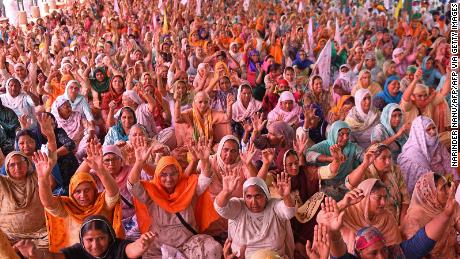
For more than a year, Indian farmers have fought against three laws, which they said leave them open to exploitation by big corporations and could destroy their livelihoods. Laws passed last September loosened rules for the sale and pricing of produce that have protected farmers from an unregulated free market for decades.
Under previous laws, farmers had to sell their goods at auction in their state’s Agricultural Produce Market Committee, where they were guaranteed to receive at least the minimum price agreed upon by the government. There were restrictions on who could buy, and prices were limited for essential items.
The new laws destroyed this structure, instead allowing farmers to sell their goods to anyone at any price. The government said reforms were needed to modernize the country’s agricultural industry, but many farmers argued that they would allow large corporations to lower prices.
In mid-January, the Supreme Court of India temporarily suspended the laws. But Modi failed to quell the protests, with some farmers vowing not to leave until the law was repealed altogether.